We shape our English curriculum so that it is taught in line with the expectations of the Primary National Curriculum and we deliver a broad, balanced and inclusive curriculum. This covers five main areas: reading, speaking and listening, writing, spelling and handwriting. Through the English curriculum, we aim to develop the life-long skills and knowledge for children to communicate their ideas and emotions so they are able engage in all aspects of society.
Synthetic Phonics is a way of teaching reading. Children are taught to read letters or groups of letters by saying the sound(s) they represent. Children can then start to read words by blending (synthesising) the sounds together to make a word.
At Longleaze Primary School we follow a systematic approach where each grapheme is introduced clearly; a focus is placed on blending to read and segmenting to spell. This focus provides children with the skills they need to begin to read words, captions, and whole sentences as soon as possible. We teach phonics using Little Wandle.
To find out more information about how and what we teach follow the link below
https://www.littlewandlelettersandsounds.org.uk/resources/for-parents/
What is the Year One Phonics Screening Check?
The phonics screening check was introduced in 2011-12; it is a short, light-touch assessment to confirm whether individual children have learnt phonic decoding to an appropriate standard. It consists of a list of 40 words, half real words and half non-words, which all Year 1 children read to a teacher. It takes place at the end of Year 1 and is a statutory requirement. If children do not pass the phonics screening check in Year 1, they will retake it in Year 2.
Phonics and Early Reading Policy
Programme overview for Reception and Year 1
A Longleaze Reader
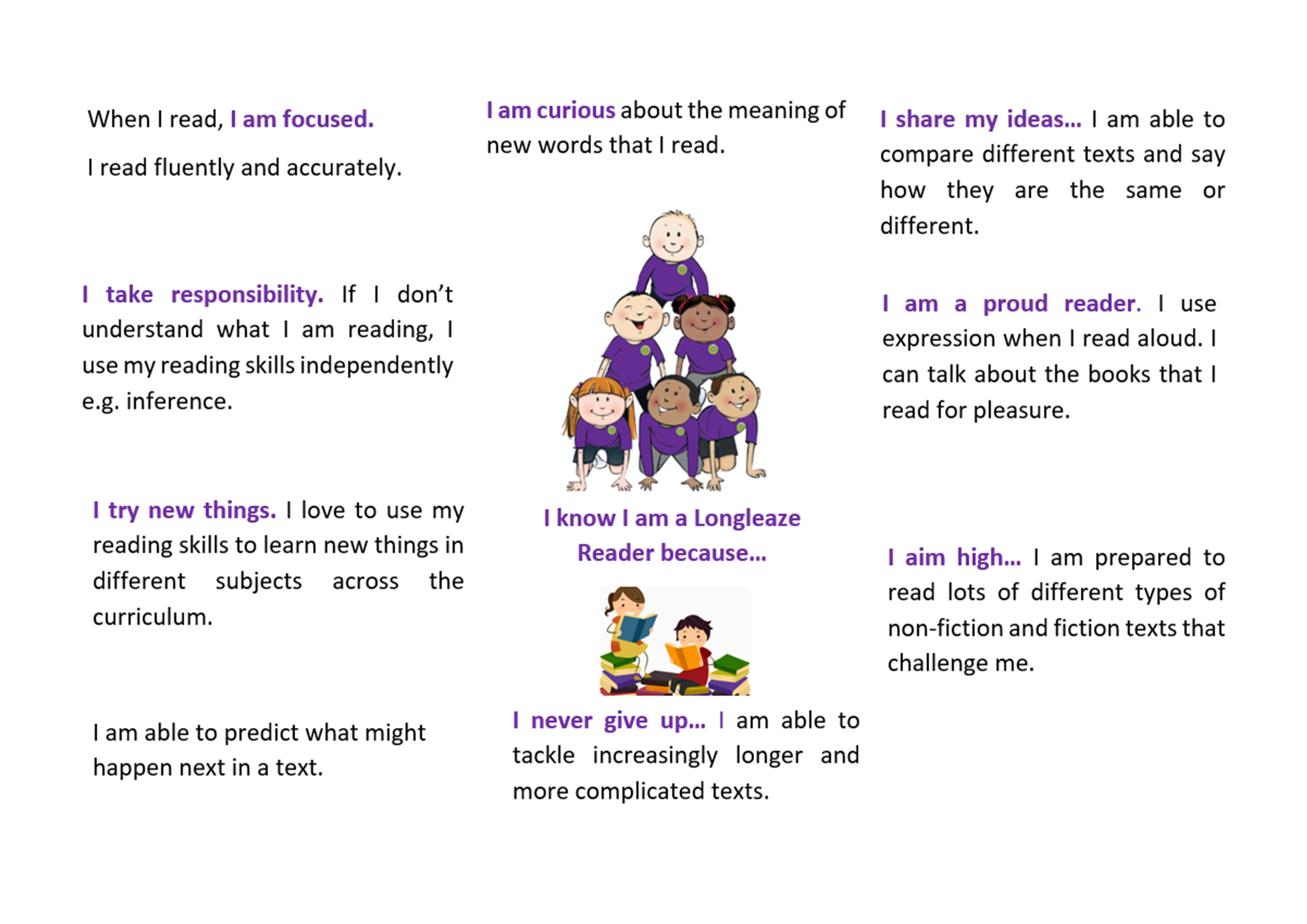
At Longleaze Primary School, reading is promoted as an intrinsic part of teaching and learning; it forms a pivotal part of our curriculum. We believe that learning to read and reading for pleasure transforms children’s lives.
Early Reading
Children practise reading using fully decodable books that are closely matched to their developing phonic level. We use Collins Big Cat (for Letters and Sounds) texts which are supplemented with several “real books”. These help to instil a love of reading in our pupils. Books are closely matched to the phonics programme and are grouped accordingly.
Teacher-led guided reading sessions take place in small groups. Children read a carefully selected engaging text. The initial focus of the session is on the three key components of reading fluency:
- accuracy
- automaticity (rapid recall of whole known words)
- prosody (reading with expression)
Children then return to the text to explore the content of the book. They are taught retrieval, vocabulary, inference and prediction skills.
Once children become fluent readers, a range of books is provided to allow them to engage in more lengthy discussions about the content of the book to deepen their understanding and broaden their vocabulary.
The Teaching of Reading in Key Stage 2
In Key Stage 2, pupils are taught an increasing range of reading skills which include authorial choice, comparing and contrasting and summarising.
More information about how reading is taught at Longleaze School can be found in the document “The Longleaze Approach to the Teaching of Reading”.
A Longleaze Writer

Welcome to our writing page,
At Longleaze we believe it is important that all children are able to communicate and express their ideas and emotions through writing. We follow the ‘Talk for Writing’ approach in our writing lessons.
Talk for Writing enables children to imitate the key language patterns they need for a particular text type orally before they try reading and analysing it. Though fun activities that help them to rehearse the tune of the language they need, followed by shared writing to show them how to craft their writing, children are helped to write in the same style.
The process includes three main stages, usually taught over three weeks CLICK HERE
Intent, Implementation and Impact statement
Welcome to our spelling page,
Learning to spell is a challenging but essential skill for children. Children simply learning spellings by rote and then completing tests does not lead to long term improvements. Instead, learning about spelling patterns and rules has been found to be more beneficial.
At Longleaze Primary School, we begin the teaching of spelling through the teaching of Phonics. From year 2 to year 6, the children follow the national curriculum objectives and learn spelling rules and patterns. The spelling rules and patterns we teach in each year group can be found below.
Here are a few activities from the No Nonsense Spelling Scheme which you can use to support your child’s spelling.
In each year group, there are common exception words that the children should be able to read and learn how to spell. These are covered in school but can be practised at home.
Year 3 and 4 statutory spellings
Welcome to our Handwriting page,
Handwriting is an essential skill. It has been linked to improved academic success and self-esteem. Regularly practising our handwriting ensures that our work is legible and that we can write fluently for sustained periods.
As a school we follow the Penpals scheme. This provides us with a consistent approach enabling us to make progress across the school. In the “Penpals Scope and Sequence” document below you will be able to see the sequence that handwriting is taught at Longleaze Primary School. The correct formation for letters, numbers and joins at our school is in our “Penpals Information for Parents” document.
Penpals information for parents
Fine Motor Activities
Fine motor skills involve the coordination of small muscles and movements of the hands, fingers, and eyes. Developing these skills enable children to hold their pencil and manipulate it effectively.
Fine Motor Activities to try at home:
- Threading with string, pipe cleaners and straws
- Rolling and squashing play-doh
- Squeezing pipettes
- Cutting shapes and lines
- Dotting with cotton buds
- Pinching with pegs and tweezers
See the link below for some great examples to use!
Fine motor activities to try at home